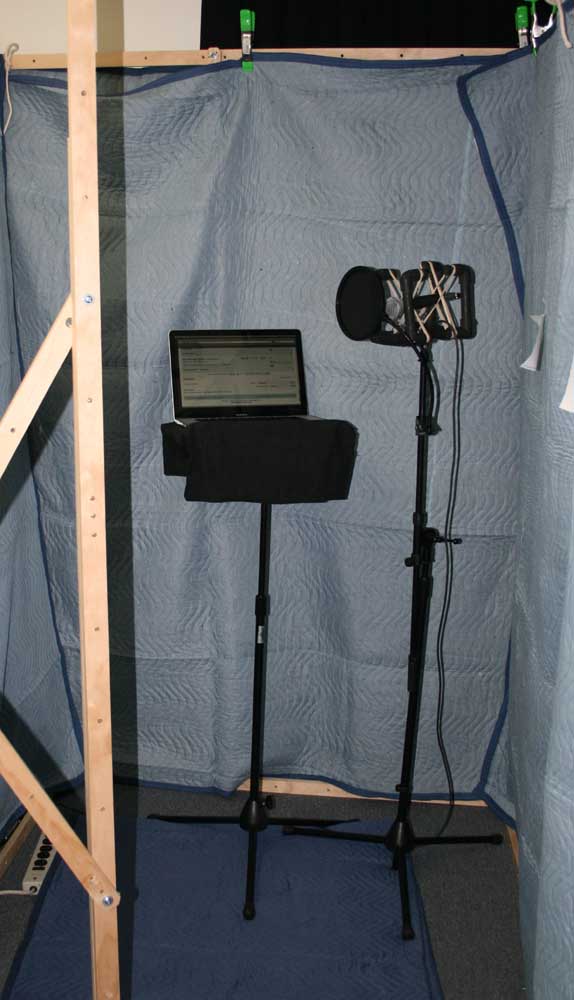
Tantor Studios in US say my noise floor is too high - its -75dB!

Ive beeen an audiobook narrator for 5 years and I’ve done over 70 titles using audacity - I find it super intuitive, and have never had any problems. I use a Bai Fei Li V5 mic plus a UA Volt 2 and. fanless macbook air with an M2 processor in my tiny rockwool clad cupboard - sorry sound booth.

I record for a number of publishers (never done ACX though). I send unprocessed WAV files , the producers hate it if I do anything at all to them. Its up to them to stick on a noise gate and work their magic. My studio does have a slight ring to it because its narrow with parallel walls so I recently added a reflective shield which i thought fixed it.

So - my agent suggested I try out for Tantor, a US studio that pay REALLY WELL but they have rejected my studio sample, saying the following

The roomtone is louder than we would prefer from a raw signal when brought up to our levels. While I can run a denoiser on this signal to get the roomtone in decent shape, it would be best to deal with this at the source instead of relying on over processing. A reduction in the roomtone by 5-10 dB while keeping the signal where it is at is recommended.

I was a bit gobsmacked so ran it through analyse ACX and it gave me the following - noise floor -75dB (pass), RMS -38dB (too quiet) Peak level -11db (too quiet)

To me this doesnt make sense. The noise floor is super low but everything else is too quiet? Is it my settimngs? Reallyt I’m looking fro something I can do to my studio to make this right. Maybe they amped it up to a level they could work with, which then made the noise floor too low. The WAV file is too big for this forum, but can I send you a link or something?

I’m at a loss. Help!

Thank you!

The ACX requirements are for RMS to be between -23 and -18dB. If you amplify by 18dB your noise floor is going to increase by 18dB and you’ll be out of spec.

…Your signal-to-noise ratio is not good enough. :frowning:

If it’s for ACX, 18dB of gain and that will push your peaks into clipping so you need to limit the peaks. ACX (oddly) requires peaks of -3dB or less, and in any case you can’t exceed 0dB, and you only have 11dB of headroom.

Koz’s Audiobook Mastering Macro incudes RMS normalizing and limiting to get your RMS and peak levels in spec.

ACX doesn’t care if the peaks are too low.

Noise is a separate issue. It’s difficult to meet the noise spec (without processing) unless you have a soundproof studio and really good equipment. (Usually acoustic noise is the problem.)

You probably need some noise reduction. “Regular” noise reduction is usually better than noise gating. It’s distracting if you hear the gate opening and closing. And if you use a noise gate to get complete silence (no “room tone”) ACX will reject you for “overprocessing”.

Hi

Thanks so much for this reply - but

I’m not recording for ACX I just used their stats on ‘analyse’ to check my levels.

The publishers I work for always ask for raw unprocessed WAV files, so no noise reduction or processing at all. They hate it.

I have very limited knowledge of audio processing, so some of what you said didn’t make sense to me. Sorry to be basic but are they amplifying my audio (by 18dB?) and is that why the noise floor is high?

I edit my audiobooks to cut out fluffs and the producer does the rest.

If they are amplifying what can I do, that isn’t processing - to change this? I speak 6 inches from mic, use a pop shield, work in a quiet insulated space?

Should I change settings or on my interface or make physical changes to my booth to change these stats?

why do they say I have a high noise floor when it’s -75?

My booth/cupboard is well insulated and I’m in a quiet room with no house or street noise.

Thank you for helping, I’m super grateful

Its up to them to stick on a noise gate and work their magic.

Can your regular producers do their magic, or is that a conflict?

Yes. It’s the amplification. They (or somebody) is going to amplify it. I said “18dB” because that brings your RMS level to -20dB for ABX.

Typically, you’d at-least “normalize” for 0dB (or near 0dB) peaks. Since your peaks are at -11dB, normalizing would bring your noise up to -64dB which “in my book” isn’t terrible and the noise would meet ACX, but then the RMS level wouldn’t meet ACX and maybe not “loud enough”… for whatever the requirements are.

There are broadcast standards based on LUFS which is more complicated than RMS and better correlates with perceived loudness.

A lot of modern music is Loudness War mastered for around -6 to -9dB RMS or LUFS so if you were listening to music and that was followed by your -38dB RMS recording it would be WAY too quiet and you’d have to crank-up the volume.

ACX Audiobooks are not as loud as these “loudness war” recordings.

All of the popular streaming services apply loudness normalization to make everything about the same volume and they have their different standards.

I’m sure if you listen to your recording compared to another “normal audio file”, you’ll realize how quiet it is. :wink:

I speak 6 inches from mic, use a pop shield, work in a quiet insulated space?

Speaking louder (without shouting, of course) will give you a better signal-to-noise ratio.

Some people unplug their refrigerator, turn off the furnace/air conditioner, and anything else that makes noise, and then record at quite times of the day, etc. Still, some noise reduction is often needed.

…Actual soundproofing is expensive construction/reconstruction.

The preamp in your interface will make some noise too but acoustic noise is usually the biggest problem.

Maybe you should try. It’s our opinion that if you can pass ACX Technical Specifications, you can submit almost anywhere else.

The sparkly rule we used for audiobook development is that you can’t hear the corrections.

For one example, the recommended simple Noise Reduction is 6, 6, 6. That gives a pleasant , clean reduction in background noise and you can’t hear the tool working. Same with Audiobook Mastering. It produces a performance that meets ACX volume specifications (except noise) and you can’t tell what it did.

If you’re working on soundproofing your room, I’ve gotten good results with heavy furniture moving pads.

There’s a trick to that. Don’t speak straight into the microphone. Push the microphone off center (B Position) and get closer.

Koz

I shot several voice tracks for a movie with some sticks and furniture moving blankets. Please note there’s one on the floor.

Koz

Oh… Koz’s macro does another thing. It has a high-pass filter that removes noise below the voice range.

There is usually lots of low-frequency noise included in acoustic background noise. Our ears aren’t very sensitive to low frequencies so we might not notice it, but it will show-up in the measurements. So filtering out low-frequency noise can improve the measurement even if it doesn’t change the sound, and since we’re not working with music there is no deep bass and filtering it out “can’t hurt”.

Are you listening to yourself as you perform? That’s highly recommended as you get closer to the microphone to avoid mouth and lip noises and accidental volume variations.

Koz

Can you tell if the macro is still working in the latest Audacity? 4.7.7?

I haven’t mastered the Portable Install yet and I don’t want to mess up my day-to-day 3.6.2. Every time I look away, the Developers change something just enough to cause problems.

Koz

Yes!!! (Audacity 3.7.7 :wink: )

I don’t make audiobooks but I just downloaded the macro and tried it on a random music file. ACX Check passed (except for “-inf” on the dead-silent noise floor.) The music file did NOT pass before running the macro.

I gotta get on top of this. I have a new laptop and it’s update city.

Koz