I recently purchased a Rode NT-USB mic. I am planning on using it for recording meditations. However, when I try to record my voice speaking the meditations the wave is very small. The only way I can get a decent looking wave is if I set the gain up to 98%. However, doing this causes a hiss to be heard under the recording and decreases the quality of sound in my opinion.
When I contacted the store I bought the mic from they remoted into my computer to check my settings. They confirmed that the wave looked very small when I recorded. However, they could not find anything wrong so they sent me a replacement mic, assuming that it was a mic issue. However, the new mic is doing the same thing.
I did check that I am speaking into the front of the mic. I am about 6 inches from the mic when speaking. I am using a normal conversational voice when speaking.
I checked my volume settings by going to: Settings - system - sound - (under input) device properties - volume. This volume changes the gain in audacity.
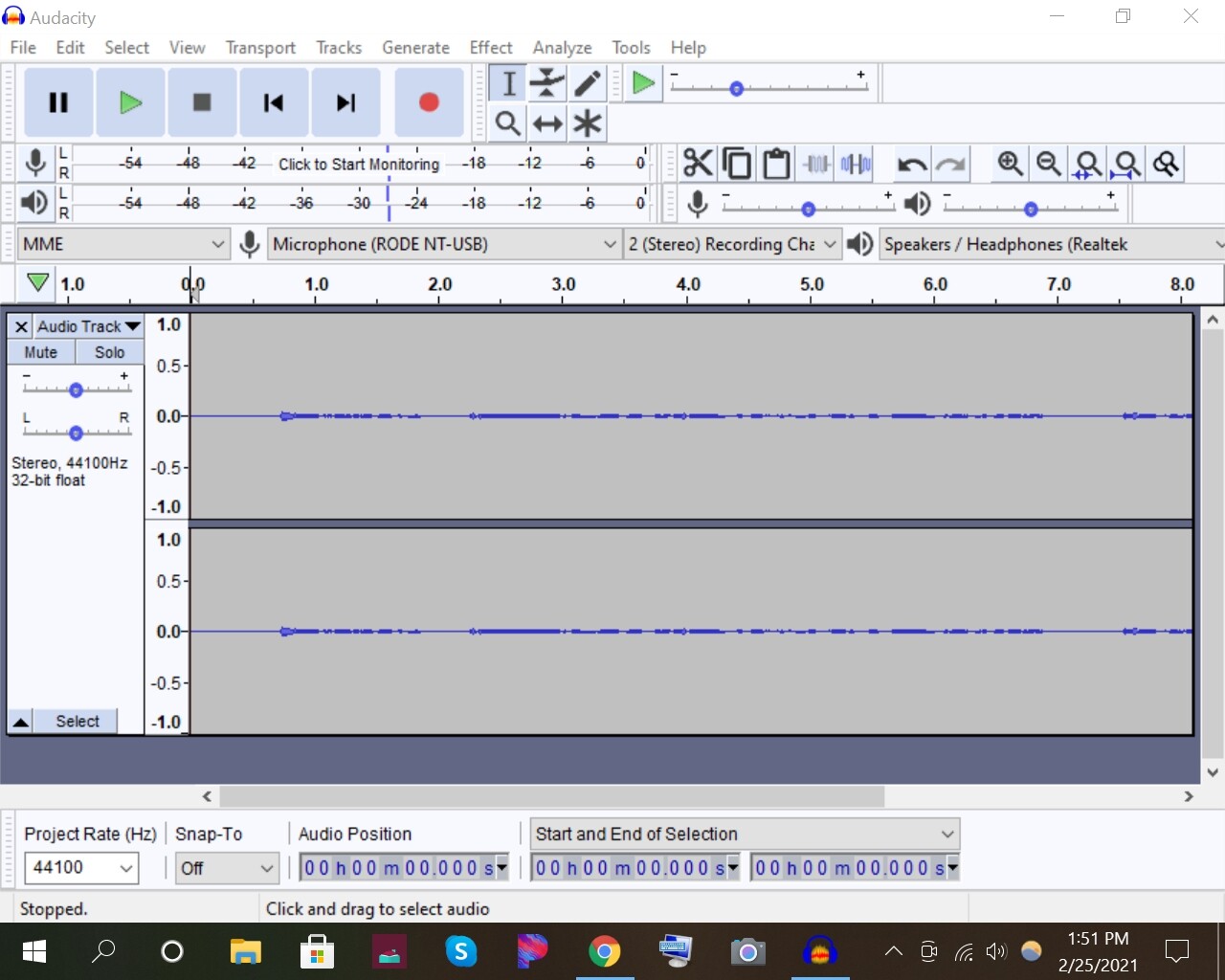
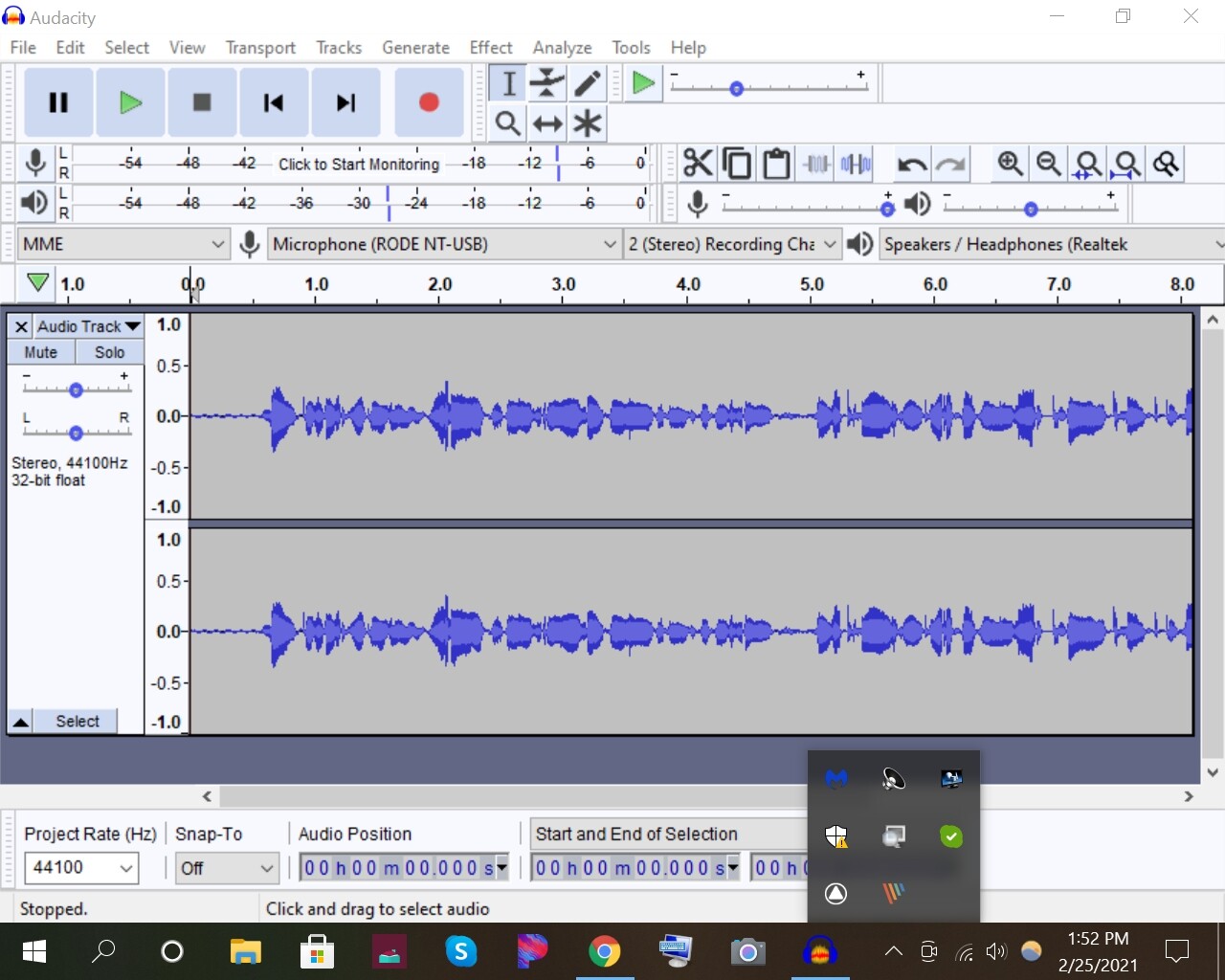
There are two attachments that I included. One is with the gain set at 50% and the other at 98%. I took a screen shot of audacity for this.
I am using audacity on windows 10. The audacity version I am using is 2.3.3
I would like to mention that I am new to recording. I appreciate any help that you can offer.
The strange thing is, Rode has a very good reputation.
Hiss usually comes from the preamp inside the mic and there is always some noise from any active electronics. Plus, you can get hiss-like acoustic noise (pink or white noise) from heating & air conditioning, etc.
If you get a high-pitch whine, that’s power supply noise getting onto the analog electronics through the USB power. The power in some computers is noisier than others and some microphones are more immune to power supply noise than others.
You can also try the Noise Reduction effect after recording. But if the noise is bad, the cure can be worse than the disease, and since the noise is bad enough for you to complain about that might not be a good solution.
I am using a normal conversational voice when speaking.
You shouldn’t be shouting but it will help if you speak with a “strong confident voice” like you are speaking to a group of people in a room. You can’t do much about the noise without changing your equipment so the only way to improve the signal-to-noise ratio is to increase the signal.
Instead of speaking directly into the microphone, push it to one side and get closer This is “oblique” positioning.
“B” can easily double your voice volume without increasing P-Popping and mouth noises. Keep facing straight ahead. This will also make the script easier to see.
Is it gentle shshshshsh rain in the trees sound? Or are you listening to the computer fan noise.
I’m having this same issue, and have been searching online as to how to fix this and haven’t found a solution yet. Were you ever able to figure this out?
They recommended 70-85 level on windows. I would go with that and watch for clipping. I’m totally new to audio btw so take my advice with a pinch of salt! Podcastage (youtuber) seems pretty credible on device reviews. He said that the Rode NT USB is prone to clipping and that he left a large headroom for input setting: https://youtu.be/_hYFYC6eEbg?si=nZdn6xVHKJwJuqEL&t=216
I suppose that makes noise reduction a bit trickier (?). I’m not sure how advisable it is to amplify things.
Digital clipping happens when you “try” go over 0dBFS which is the limit of the analog-to-digital converter (inside the mic in this case). Nothing bad happens when you get close to 0dB but there is no headroom above that.
Digital levels are not critical (as long as you don’t clip). There’s no problem turning-down the knob on the microphone and then Amplifying/Normalizing later in Audacity.
But, if the acoustic or analog level is too low, you can get a poor signal-to-noise ratio from the acoustic room noise and the noise from the mic preamp (also inside the mic). Basically, the louder the sound into the mic the better, as long as you don’t overload it.
They recommended 70-85 level on windows
That’s just a setting. It’s the actual levels (showing on the meters) that are important. It’s generally best to set Windows for 100% and then adjust the knob on the mic for peaks somewhere below 0dB. The amount of “headroom” you should leave depends on the predictability of the levels. You don’t want to clip on unexpected peaks. That’s probably only going to happen if you stick it directly in front of a drum or a loud guitar amp.
Thanks for the reply. Bit of both, mostly low levels, but I guess the need for amplification leads to increased noise ultimately? The signal to noise issue seems to be it. It’s frustrating as I speak rather low generally lol. It’s just a usb mic I got to do some promo for some projects.
Interesting, are there no downsides to setting it say 95% directly on windows then, provided I dont go into the red on Audacity? There’s no direct gain knob on the mic itself sadly. Sorry if I sound a bit dim, I’m totally knew to the world of audio but I’m keen to learn I’ve seen others recommending that I should stay below -6dB. Is this to allow for a certain amount of editing without peaking?
I keep thinking of this like exposure, coming from a photography mindset - that is, expose as bright as possible while veering towards the underexposed side on the highlights.
Ideally, you should speak with a “strong confident voice” like you are addressing a small group of people and you want to be heard, but without shouting.
Actually, that could fool you because the microphone’s ADC could be clipping and Audacity would never know. Leave it at 100%.
There’s no direct gain knob on the mic itself sadly.
I didn’t realize that. USB mics without recording volume controls are normally set/calibrated low so they don’t clip with loud sounds. That MIGHT be the root or your problem…
Like I said, with digital, nothing bad happens when you get close to 0dB. You only need headroom for unexpected peaks. But since you’re saying the level is too low, that shouldn’t be a problem.
Headroom is a funny thing… If you don’t use it, you didn’t need it. If you do use it, it’s no longer headroom!
Pros typically record at -12 to -18dB, but that’s not usually necessary.
Yeah, it’s well regarded as USB mics go in this price range but the lack of a gain knob is a bit annoying, given they added two others for headphone monitoring. I’ll try working at 100% and see if I notice any changes.
My first tests with the mic sounded harsh but I’ll try louder. I never noticed how sibilant my voice is, if that’s a word! Maybe the low signal to noise ratio of my tests accentuated that a bit, along with amplification. For audio editing, do you typically apply de-essing as a first or last step, or even both (in 2 passes)?
See if you can break it. Set up so you can watch the Audacity blue waves while you perform. Then perform louder and louder until the blue waves fill the space.
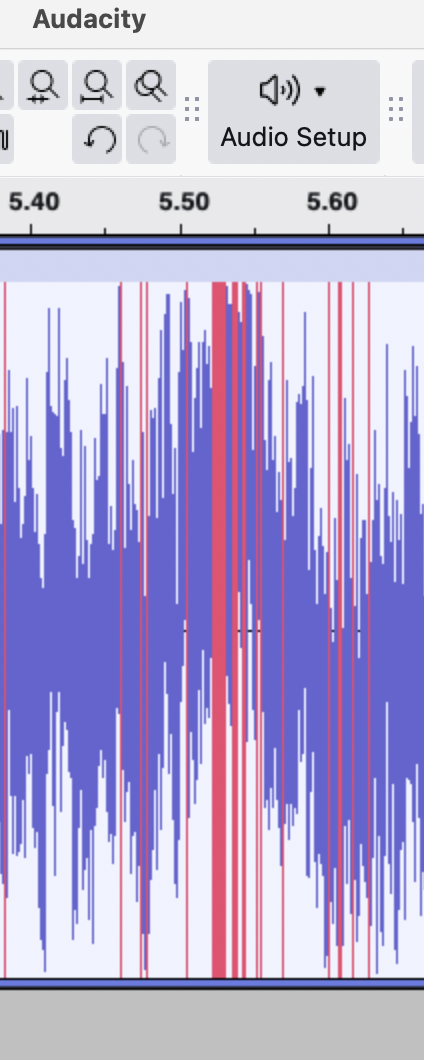
You can select View > Show Clipping and Audacity will add those red marks at the damage points.
That’s not a voice performance, I can’t get my new laptop to admit it has a microphone.
Never blow into a microphone, but you can perform/sing/yell as loud as you wish.
Another trick. Listen to the microphone with very good quality sealed-on-the-head headphones.
Those are classic Sony MDR-7502 Headphones. The movie industry runs on those because they show the audio people damage before the Director hears it.
Can you keep getting louder until your voice starts ticking and cracking? That’s the point where the microphone internal preamp runs out of steam and damages the sound.
You should be able to see that in the blue waves. That will be flat tops and bottoms before the waves fill the time line.
That brings us to another possible problem. Have you turned off all sound processing and voice management settings? If you like Skype, Zoom or Google Meat, please know that they all take over the sound in the computer and you have nothing to say about it. Even if you turn off Zoom, it will occasionally leave the processing running in the background.
Have you ever done a Windows Clean Shutdown? That’s the one that completely clears out everything while it’s shutting down. It takes longer, but it’s usually worth it.
You said a bad thing way up at the top. “I have a quiet voice” is not good news, particularly with an “affordable” microphone. Did you find yourself screaming to get the blue waves to fill the timeline?
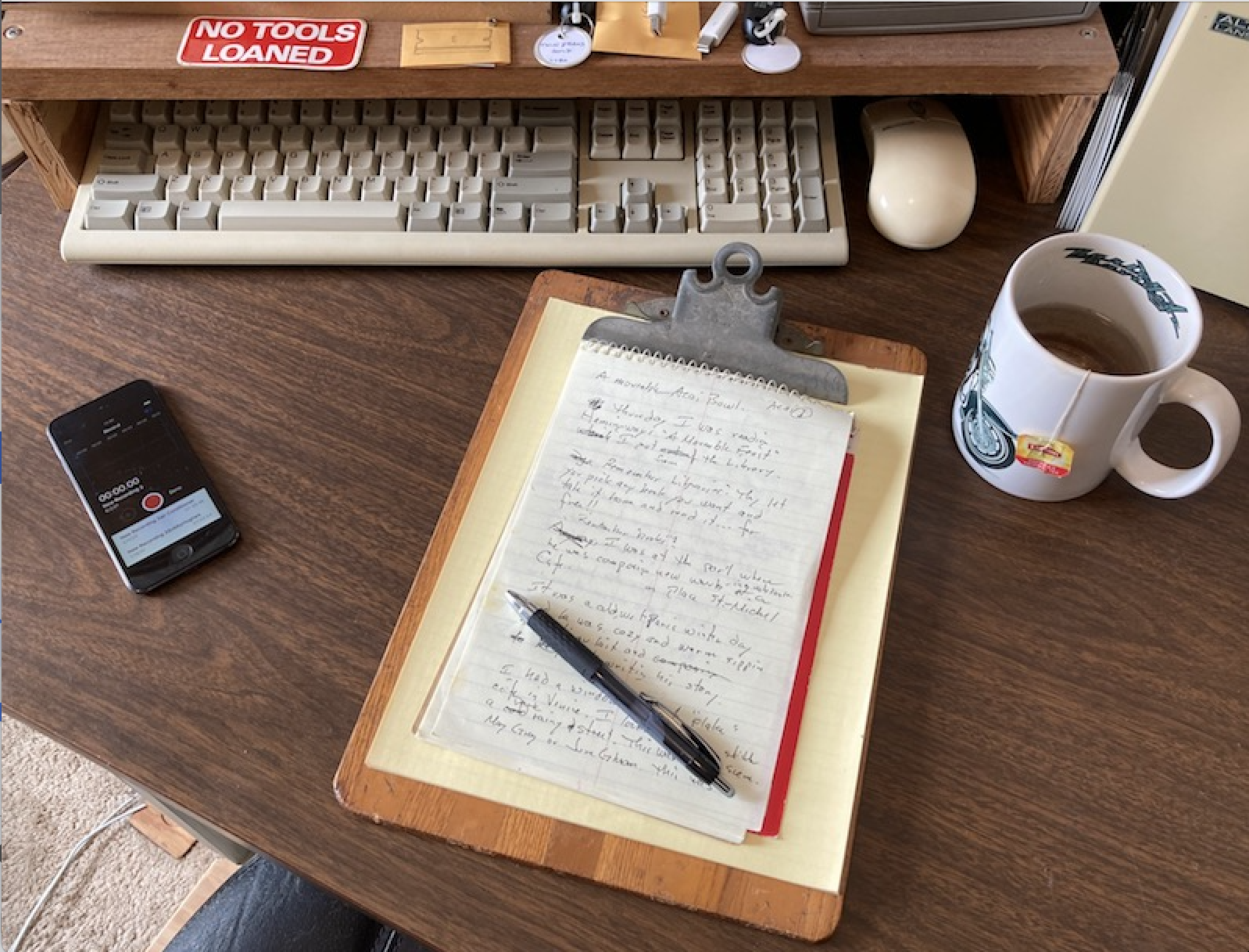
If you get tired of this juggling, you might want to try recording on your phone. Lossless Voice Memo on an iPhone is not a dreadful way to record. I have a voice sample here somewhere.
I found the illustration. If you do this for ages, you might want to put a power cable on the phone.
Leave the phone on the desk. That’s Pressure Zone Configuration. Assuming a quiet room and desk, that will double the good quality voice volume without adding noise.
Maybe it’s not. I bought an AKG professional microphone at a suspiciously good price. It did work, but it had what they said was New Professional Sound (we assume unlike their normal microphones).
That turned out to be bright, hard, and almost harsh tonal quality. I used it once. I think it’s in the garage.
Thanks Koz! Some useful info there. I’ve turned on the clipping indicator and can test later.
The Sony looks useful. I already have the beyerdynamic dt 770 pro monitor that I got for something else. Is that useful for this? I don’t have an audio interface but I’ll probably try plugging those directly onto the mic, if that’s useful. I might upload a test sample here at some point.
They need two attributes: Large, gushy pads so the sound can’t escape into the microphone, and a matching cable/connector. I have those Sony units and The Behrinhger HPS3000.
But those aren’t my day-to-day headphones. That would be the Sennheiser eH-150. They have big floppy pads, too, but they have slightly boosted Bass and restrained crispness. Nobody is claiming Studio Monitoring Quality, but I have no trouble watching a movie with those and listening to dance music. I have two sets. Someone said they’re not made any more.
Anyway, why are we doing this? It should be possible to speak very loudly and overload the Audacity timeline. Blue waves all the way up and red marks. If you can’t get the sound that loud no matter what you do or how loud you yell, then there is something in the sound processing chain that is interfering with the recording. Find it.
Same if you can get loud ticking, popping, and harsh peaking in your headphones (microphone overload), but the time line doesn’t get very loud, Something in the sound channel is messing with you.
This is where it’s not handy me being on a Mac. Windows has internal settings for sound processing, over and above processing contributed by chat programs.
Do it in perfect quality WAV (Microsoft) format. MP3 may seem to be a nice, popular sound format, but they get the convenient, tiny sound files by intentionally injecting distortion.
The forum has a size limit. Don’t go over 10 seconds of WAV file (2MB).

 I’ve seen others recommending that I should stay below -6dB. Is this to allow for a certain amount of editing without peaking?