I did entertain writing “Everybody Does This Wrong.”
Record your voice and then prepare that exact recording or sound file for posting without saving any steps in the middle. “My computer crashed and I can’t find my work. I don’t have time to read it all again.”
Also:
“ACX reject my sample. I already read the whole book. What am I going to do?”
That’s what I thought. Boost overall volume, very gentle compression (to increase loudness) and trim volume a bit.
So we officially have a studio recording and from here it’s fine tuning, maybe lowering the background noise a bit (maybe tiny noise reduction, Steve’s LF-Rolloff), polishing vocal tone for more pleasant timbre (DeEssing, Equalizer, Low Pass filter).
I have no hands-on with the DeClicker. I think that’s supposed to suppress “wet mouth noises,” which I think you don’t have. I only have minimal experience with the DeEsser, so I’m getting into deep water here.
Anyway: Normalize to 3.5dB
Compress - Default Values, 2:1
Normalize to 3.5dB
LF-Rolloff (Length about 5000)
DeEss - default values
Note: LF-Rolloff affects noise because even though it drops rumble and other earthquake noises (that only cats can hear) with minimal affect on the show, those noises are measured in ACX testing. So it’s one of the effective corrections that you can make that’s very nearly “free.”
What are your thoughts on that corrected clip? You are about to experience another benefit of a studio recording. You have options. People in constant Disaster Recovery don’t.
Goodness! Well I’ve not tried Steve’s LF rolloff (I don’t think - although who knows, I’ve played with so many different things my brain is frazzled. I’ve spent waaaaay more time on this then I ever did on my degree. True story), but it sounds like it gets rid of all the messy stuff, so that can only be a good thing. The occasional cuckoo does seem to turn up on my recording (Where from? What do they even LOOK like?) so getting that automatically filtered without messing voice tone would be great.
Blushing
Yeah, I’ve just been pausing and waiting for them to pass. If it was a commercial situation it would be really annoying but airforce practice (I’m guessing) flights only really take up a small portion of the day. Although this morning I was up at 5am to get a couple of recording hours in - the planes usually start at 8.30-ish. Actually sometimes I really like the sounds and rush to the window to see what jets they are and how low they are flying - is that too geeky?
For me remembering character voices is a never-ending trial. If I can get the tech process as smooth, controlled and predictable as possible I only need to worry about the read. It’ll be so much better!
Really clean - almost, dare I say, professional sounding! I can hear mouth noises with my work - but I guess I’m more tuned in to my voice because (obviously) I spend so much time listening to it! I swear to god, sometimes I sound like an elderly lady, moving her false teeth around and sucking on a hard candy at the same time! It’s really good to know that there isn’t huge amounts to do, just tweaking. I know a massive problem is record volume - and that should improve with a better mic, from what I’ve been reading (mine is a USB Snowball - bought it before I’d done any research ).
I can’t even begin to tell you how much help this forum has been - not just now that I’ve actually posted but with all the posts I’ve read up till now as well.
Ooooooo (lightbulb) so you mean the goal is to get it passing ACX and THEN do the (totally hands off) noise reduction, LF-Rolloff, DeEssing and Equaliser? I thought you had to do all this to GET the pass. Ahhhh (shakes head) feel a bit silly but that makes so much more sense. Pass the recording then address the tone without affecting any of the actual levels. Totes, dude.
Mastering for the ability to become the (insert male boomy echo voice) ‘Master of the Audio-Universe’, of course. I can’t believe that needed to be spelled out…
Ha! I appreciate your effort.
‘Claire has now exited the forum, is sipping on an ice-cold glass of Moet, listening to the gentle roll of the ocean and eating a soft-serve ice cream with gooey toffee sauce. Sigh…’
The thing that gets me is that audiobooks aren’t cheap to buy, I’d hate to shortchange listeners who have either spent actual money or used their credit on my product, just to get a substandard experience. I really don’t understand why people don’t do research first. I don’t have a technical background and most of this stuff goes waaaaay over my head, but if I’m asking people to spend their wages on my recording, it’s just rude not to at least try.
My recording space is a home-made booth made out of 2x4 planks of wood, surrounded by three layers of packing blankets and a quilt. It gets pretty hot so I’m looking forward to recording in winter! The whole thing literally cost about £20 in materials and half a day of work to assemble. It sits next to the front door, because we are in a teeny-tiny one bedroom house, attached to both of the neighbours either side. Like I said my mic is USB (Snowball) and I know it’s not going to do the job long-term so already I’m planning for that to be my first upgrade.
My point is: it doesn’t cost much, just a bit of effort. It won’t be forevermore, hopefully I’ll be able to move to a more professional set-up in time, but sitting at the kitchen table with a mic and expecting to produce a decent sound? Now that’s just naive and kind of disrespectful to ‘proper’ professionals and the listener!
Okay, that was a bit of a rant. Part of me is still in the Riviera…Fetch me my sunscreen! Get me a top-up! You! More ice-cream, stat!
ACX Test is for basic technical competence, full stop. From there, it goes to ACX Human Quality Control where they check for basic theatrical competence. Then they check your ability to follow instructions (put x number of silent seconds before each chapter). Scarily, we have had posters fail the last one.
Then they publish with the assumption everything else is between you and the client.
Seems simple, doesn’t it? Most new users crash at step one. That’s why it’s automated.
You fell into an item from my book list. “If only I could find the right microphone, all my problems will be over.”
Probably not. You might get small quality improvements, but few people, short of using a very special purpose microphone, pulled their show out of the trash with a new mic. I used a head-mounted, theatrical microphone in my podcast test because I couldn’t do the show in my “studio.” See: Las Vegas and TED Talks. That case does work.
In my opinion, your “wet mouth noises” are fine, but feel free to experiment with the DeClicker. Almost everybody hates listening to their own voice, so don’t overdramatize the noises.
I have a copy of that on kozco.com. Download that zip file and decompress it to LF_rolloff_for_speech.xml. Install it in the Equalization tool.
Adding Audacity Equalization Curves
– Select something on the timeline.
– Effect > Equalization > Save/Manage Curves > Import
– Select LF_rolloff_for_speech.xml > OK. (it won’t open the ZIP. You have to decompress it)
– LF rolloff for speech now appears in the equalization preset curve list.
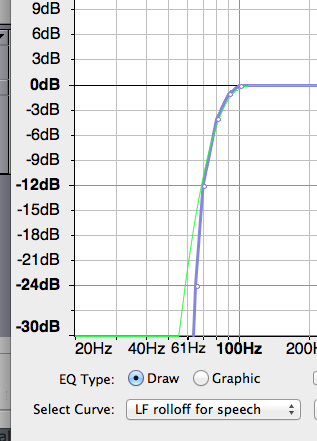
It will look like this when you use it.
Set the Length of Filter slider to the right around the middle—about 5000.
Tonal pitch is along the bottom and loudness is up the left. Officially, the filter is a 100Hz cut filter and a version of it is included with many portable/field sound mixers. As tonal pitch passes 100Hz and lowers to the left (organ pedal tones), the filter suppresses them harder and harder as you go. 60Hz and 50Hz, the power or mains frequencies in the US and the UK are very firmly reduced and most earthquake and thunder tones are almost completely missing.
Your microphone produces tones like that by accident and they just vanish after the filter. Since you’re a woman, it doesn’t affect your vocal tones at all. Everybody wins.
I really like the sounds and rush to the window to see what jets they are and how low they are flying - is that too geeky?
You have to click it. It’s too big for forum formatting.
[geeky]Someone will correct me but that’s a Boeing 777 notable for its grouping of three pairs of wheels on each side landing gear.
The distance from the center line of LAX Approach 24R to the property line of the restaurant is about the same as the wing-tip width of an Airbus A380. [/geeky]
That’s not trick photography and the only Photoshop involved is brightness adjustment and fuzzing people’s faces.
It is basic photography. Tell a story, provide context, put the viewer in the scene. Tourists normally wander into the public park and take pictures from there. My joke is about watching them elbow each other out of the way. Because the jet motion confuses smartphone auto focus, you usually get this.
You might well think this would be the perfect place to get jet sounds (dragging this back to Audacity). It’s not. There is little or nothing between this park and the Docweiler Beach breeze, and microphone wind socks or shields screw up the jet roar. Trust me on this. After I protect against wind noise, there’s nothing dramatic about the sound at all.
This sound recording thing isn’t as easy as it looks.
What? You don’t keep a portable recorder with you?
This isn’t the first time I suspected the recorder was doing processing to “help me.” In an earlier part of the clip I think I can detect that weird, wine-glass cellphone sound of it trying to suppress all that water “noise.”
No sh$t, Sherlock (do you have that saying in America?)
Errrr…(whistles awkwardly and looks at the ceiling…)
Lol. And…Lol.
Modern life has disappointed me. Where are the jet-packs we were promised? Sure, we stole tablets from Star Trek, but where are the amazing food-prep machines? “Computer, makes me an ice-cream sundae. Stat”.
Okay, back to audacity…
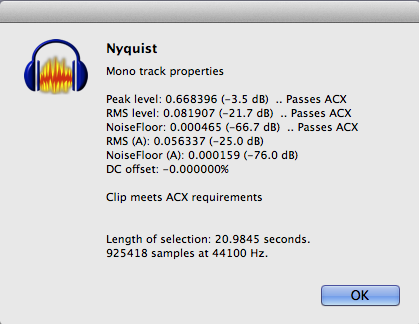
Soooooo (sigh) I took this to a larger file and my question is quite simple: if a file to begin with has a Nyqvist ACX check reading of Peaks 0.0 and RMS -29.1, does that basically mean delete it and record because the differential is too great to account for the reverse correlation that takes place when you normalise and compress? It’s just on the 20 minute file with those peak/RMS readings it took a lot of repeating processes to get a pass and I was thinking - this must be an example of a recording just not being good enough to master in the first place?
You should be able to see that. View > Show Clipping. Red band in the blue waves or more than one? That correction may be a little extreme for Effect > Compression. You may be wanting Effect > Limiter. Limiter is the one that attacks high peaks and leaves everything else alone.
I’m assuming there is minimal damage and each high peak is not whacked off (so to speak). If you exhibit flat tops on these waves that’s more like permanent damage. If you play through that segment and hear a crack or click, then that portion is permanently damaged.
You can try Clip Fix, but that doesn’t actually put the sound back the way it was. It makes a good faith guess what the original must have been had it been there (to dip into the subjunctive) based on character of surrounding work, analyzing wave slopes, eye of newt…
If it’s really brief (one of the spangles from your tiara accidentally touched the microphone), then you might get away with just magnifying the blue wave and surgically removing it. Not all errors need advanced programming.
If an entire segment of the work turns up red bands. You’re dead. Time to reread.
And that brings us to the reason the Audacity sound meters are much larger in later versions. So you can see them out the corner of your eye and not produce works that are a forest of bright red overload lines or barely visible blue waves.
You don’t even have to make out the position or value. They change colour. Some greenish-yellow when you’re about right transitioning through the warm colours and flashing bright red when it’s almost certain you’ve produced some damage.
It’s an attractive idea to set Audacity recording and then come back in a half-hour to press Stop on a perfect product, but it rarely works like that.
Not always. It is unfortunate if your natural presentation includes high, needle-like peaks in the blue waves, but that’s not deadly. That can respond to Effect > Limiter whose job it is to squash those peaks in preference to the overall volume. I don’t remember if Limiter is included in the stock Audacity.
If those relationships are too far off, you’ll never get there. Fixing one can kill the others. That’s why it’s important to get close in the original recording. Too much processing is actually an ACX AudioBook failure. So no you can’t beat your show with a stick and submit it because it passes our analysis tools.
The goal is listening to someone across the kitchen table from you, not a cellphone call.
I have a very quiet third bedroom and I have created several voice pieces that needed minimal processing to make ACX Compliance. One of them with the built-in microphone on my laptop.
 ).
).